What Makes a Trustworthy Script Author? Signals to Look For
On RblxScript, authors publish scripts without a review first, so who uploaded a script tells you a lot. You cannot check the code of every script you find. You can check the person behind it in about two minutes, and most trustworthy authors leave clear signals on their pages.
Signal 1: The same name everywhere
Trustworthy authors keep one handle across platforms: their RblxScript profile, the repository that hosts their code, the Discord they run and the YouTube channel where they show their scripts working. When all of those match, you can check one to vouch for the others. When the "official" Discord has a slightly different name from the profile, stop there.
Signal 2: A history with real replies
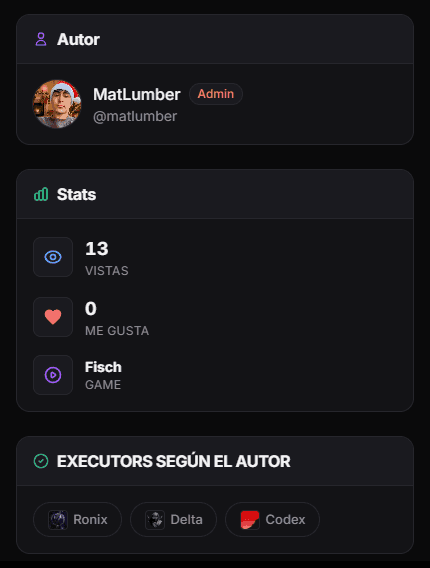
An author's profile on RblxScript shows every script they have published. A healthy history has several scripts spread over months, with comment threads where the author actually answers bug reports and questions like "when is the fix coming". One upload from six months ago with no replies is a much weaker bet.
Signal 3: Honest patch status
Authors who care about their name mark their own scripts as "patched" as soon as they break. Others leave the page on "working" until the comments fill up with complaints. Open the oldest script an author has. Did they update its status, or has it said "working" for months while every recent comment says otherwise?
Signal 4: Descriptions that name limits
Good descriptions are specific. They name the features, the executors used and what the script does not do. Lazy ones read like a sales pitch: "best script ever, super OP, 100% working". Specific details are hard to fake, because anyone who runs the script can check them.
Here is an example from our own channel. The description of the Fisch video below lists chapters for each feature shown (Auto Fish, Auto Cast, Auto Shake, Auto Reel, shops, quests and teleports), says it was run with Delta, and adds that the video covers only the features on screen, not a future event. That is the level of detail to look for.
Signal 5: A way to reach them
Reachable authors put a Discord server, a YouTube channel or another contact path on their profile. Anonymous authors are not always bad, but nobody can hold them to account when something goes wrong, and a script that vanishes with its author leaves you with no fix.
Signal 6: They never ask for your account
A script is text you copy into an executor. It never needs your password, your browser cookie or a 2-Step Verification code. Roblox says so directly on its support site:
If someone tells you they know this awesome trick or hack and just need some particular information from you to get it to work, they are just trying to steal your account.
Red flags at a glance
| Green signal | Red flag |
|---|---|
| Same handle on every platform | A Discord or channel with a slightly different name |
| Replies to recent comments | No replies, or comments turned off |
| Marks broken scripts as "patched" | "Working" for months while comments say otherwise |
| Lists features, executors and limits | "100% undetected", "no ban", "super OP" |
| Script is plain code you copy | Asks you to download an .exe or turn off your antivirus |
| Never asks for account details | Asks for your cookie, password or 2SV code |
A two-minute check before you copy anything
- Open the author profile from the script page and count how many scripts they have and how old they are.
- Read the five most recent comments on this script. Look for dates, executors and "patched" reports.
- Search the author name on YouTube or Discord and confirm the handle matches exactly.
- Read the code if it is short. A script that loads more code from an unknown address you cannot open is a reason to wait.
- If anything asks for your login, a download or a disabled antivirus, close the page.
What badges mean on RblxScript
Some authors show a badge next to their name, such as "Admin" for people who run the site. A badge tells you who the account belongs to. It does not mean anyone tested the script, and RblxScript does not test scripts before or after they are published. Treat a badge as one signal among six, not as a guarantee.
Keep Your Account Safe (Roblox Support)
The official list of what you should never share, and how to turn on 2-Step Verification.
How scripts get published on RblxScript
What the site checks on upload, and what it does not review.
Account safety guide
Practical steps to protect your account and your device.
Script library
Browse every public script and open the author profile behind each one.